Why the network inside the facility matters just as much as the one connecting it to the outside world
Data centers are built around connectivity. Fiber, carrier diversity, redundant paths, high-capacity networks, and increasingly sophisticated infrastructure are all designed to keep data moving reliably between the facility and the rest of the world. But there is an important part of the connectivity conversation that often receives far less attention: Data Center Wireless Infrastructure and how wireless connectivity performs once you are inside the building.
A data center can have extraordinary external connectivity and still have areas where cellular coverage is weak or nonexistent. That becomes increasingly important as facilities grow larger, more complex, and more dependent on people, wireless devices, security systems, sensors, and operational technology. The network bringing data into the building may be engineered to extraordinary standards, while the wireless environment inside the building can remain an afterthought.
For the people responsible for operating these facilities, that gap can create real operational problems. Engineers and technicians need to communicate while moving through equipment areas, loading docks, mechanical spaces, stairwells, and other locations where traditional cellular signals may struggle. Security personnel need dependable communications throughout the property. Vendors and contractors need to stay connected while working on-site. In an emergency, the ability to communicate reliably is not something a facility should have to question.
Data Center Wireless Infrastructure: A Different Connectivity Challenge

Data centers present some unique RF challenges. Large amounts of concrete and steel, equipment racks, mechanical infrastructure, electrical systems, security environments, and highly compartmentalized spaces can interfere with wireless propagation. As facilities become larger and more sophisticated, simply assuming that an outdoor cellular signal will make its way throughout the building is increasingly unreliable.
This is where indoor cellular infrastructure, including Cellular DAS, becomes important. A properly engineered system can distribute cellular coverage throughout areas where signals would otherwise be weak or unavailable, providing a more consistent wireless environment for employees, contractors, and operational communications.
The goal is not to replace fiber or the data center’s wired network. It is to address a different problem. Fiber provides enormous capacity between systems and locations; indoor wireless provides mobility and communication for the people and devices operating within the facility.
The two should be viewed as complementary layers of infrastructure rather than competing technologies.
Wireless Is Becoming Part of Data Center Operations
The workforce inside a modern data center is increasingly mobile. Technicians move between rooms, engineers troubleshoot equipment across different areas, security teams monitor access points, and contractors perform maintenance throughout the facility. Many of these activities depend on mobile communication, authentication, monitoring, and connected devices.
At the same time, data centers are becoming more automated. Sensors, access control, environmental monitoring, security systems, asset tracking, and other IoT applications are expanding the number of devices that need reliable connectivity within the building.
That makes the wireless environment part of the broader operational infrastructure rather than simply a convenience for employees.
For facility owners and operators, the practical question is whether the wireless infrastructure has been designed with the same level of consideration given to power, cooling, fiber, redundancy, and physical security.
Where Wireless Coverage Matters Most
A strong indoor wireless strategy should account for the areas where people and systems actually operate, including:
- Equipment and technical areas where engineers and technicians need reliable communication.
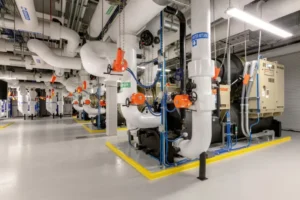
- Mechanical rooms, loading areas, stairwells, and other spaces that can be difficult for cellular signals to penetrate.
- Security and access-control locations where personnel need dependable communication.
- Common areas and administrative spaces used by employees, vendors, and visitors.
- IoT and operational technology environments where wireless devices may support monitoring and automation.
- Emergency situations where reliable communication throughout the facility becomes particularly important.
This also requires understanding the difference between cellular, Wi-Fi, and other wireless technologies. Wi-Fi can provide excellent connectivity for managed devices and applications within a controlled network environment, while Cellular DAS can provide broader carrier-based cellular coverage throughout the property. In many facilities, the strongest approach is not choosing one over the other, but designing the two systems to work together.
Connectivity Should Be Designed Into the Facility
One of the mistakes I have seen throughout the wireless industry is treating indoor connectivity as something to solve after the building is already operational. Retrofitting infrastructure is possible, but it can become considerably more complicated when pathways, equipment locations, ceilings, power requirements, and access have already been established.
Data center developers and engineers have an opportunity to approach wireless differently by considering it during the design process. Coverage requirements can be evaluated alongside the building’s other infrastructure, allowing the appropriate pathways, equipment locations, power, and service requirements to be incorporated before construction is complete.
That becomes even more important as data centers continue to evolve. The facility being designed today may operate for decades, while the technology used inside it will change many times during that period. Infrastructure needs to provide enough flexibility to accommodate that evolution.
The Bigger Infrastructure Picture
The data center industry has done an excellent job of recognizing that connectivity is mission-critical. The next step is recognizing that connectivity does not stop at the building entrance.
Fiber connects the facility to the world. Wired networks connect systems within the facility. Wi-Fi and cellular infrastructure connect the people and devices moving through it. Security, IoT, automation, and operational technologies increasingly depend on all of these layers working together.
For owners, developers, engineers, and operators, the takeaway is straightforward: the wireless environment inside a data center deserves the same level of planning as the infrastructure connecting it to the outside world.
A facility can have redundant power, sophisticated cooling, diverse fiber routes, and exceptional physical security, but if the people operating it cannot reliably communicate in critical areas, there is still an infrastructure gap.
The next generation of data centers will be defined not only by how much data they can move, but by how effectively every part of the facility can stay connected.
Go Deeper: Connectivity-as-a-Service
The shift toward treating connectivity as core building infrastructure is explored in greater depth in our research paper, Connectivity-as-a-Service: The New Infrastructure Standard for Modern Buildings.